






































Article 6.2 projects, from host-country screening to authorized outcomes
See how we assess host-country frameworks and project eligibility, so your mitigation outcomes are ready for authorization and international transfer.
Why Article 6.2 changes the value of carbon credits
What it is

Article 6.2 lets countries cooperate to transfer Internationally Transferred Mitigation Outcomes (ITMOs) toward their national targets. Corresponding adjustments prevent double counting.
Why it matters

It connects national climate targets with international carbon-market finance, across renewable energy, energy efficiency, waste, land use, removals, and other eligible activities.
Market opportunity

Buyers get access to internationally authorized outcomes aligned with national climate frameworks, in emerging sovereign carbon markets.
Business value

Host-country authorization can raise the strategic and commercial value of a project's mitigation outcomes.
From eligible activity to transferred outcome, in six stages
Follow the six stages we run with you, and see what each one asks of your team.


Two routes to international carbon markets
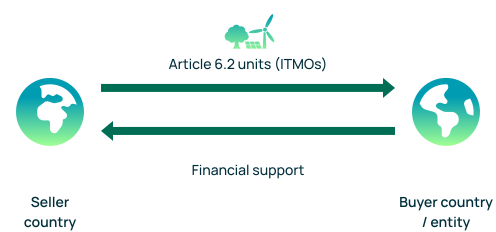
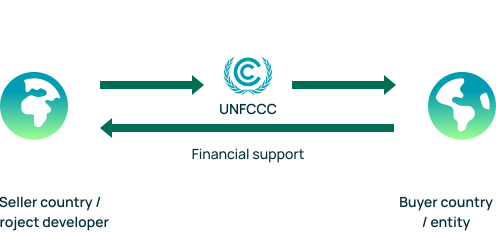
The host country can decide whether to authorize A6.4ERs or not.
If authorized: A6.4 Authorized Emission Reductions (A6.4 AER), which become ITMOs.
If not authorized: Mitigation Contribution Units (MCUs).
If not authorized: Results-based climate finance, domestic mitigation pricing schemes, or domestic price-based measures.
Article 6.2 questions, answered plainly
Find the basics on how authorization and transfer work. For anything about your own project, talk to us.
Article 6.2 of the Paris Agreement lets countries cooperate directly and transfer mitigation outcomes between them. Those outcomes are called internationally transferred mitigation outcomes (ITMOs).

An ITMO is a mitigation outcome that is authorized by the host country and can count toward another country's climate target. It is the unit that moves in Article 6.2 cooperation.
A corresponding adjustment is an accounting step where the host country adds the transferred outcome back to its own emissions record. It prevents the same reduction from counting toward two countries' targets.
Authorization is the host country's formal approval for a mitigation outcome to be used for transfer. Without it, the outcome cannot be treated as an ITMO.
We assess the host-country framework and your project's eligibility, then help you prepare for authorization and transfer. Our focus is making your project ready before the rules and buyers ask for proof.