






































Article 6.4 projects, from eligibility check to issued outcomes
See how we assess your activity against Article 6.4 rules and methodologies, so you enter the UN-supervised mechanism with a project that fits.
Why Article 6.4 matters for project developers
What it is

Article 6.4 sets up a UN-supervised crediting mechanism under the Paris Agreement. It generates mitigation outcomes through standard methodologies, rules, and central oversight.
Why it matters

Central governance brings more consistency to project assessment, methodologies, monitoring, verification, and issuance.
Market opportunity

The mechanism covers renewable energy, energy efficiency, waste, removals, and other eligible activities, with growing relevance under the Paris Agreement.
Business value

Developers reach an internationally governed market. Buyers source outcomes from one common framework.
From eligible activity to issued outcome, in six stages
See where methodology, validation, and registration come in, and what authorization adds.


Two routes to international carbon markets
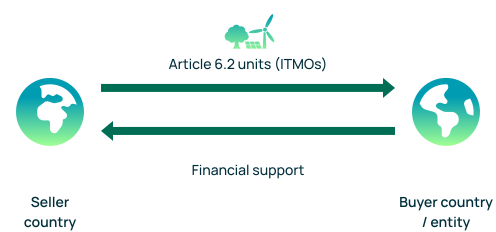
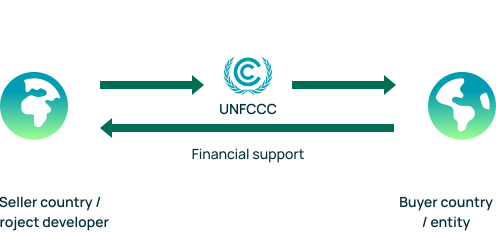
The host country can decide whether to authorize A6.4ERs or not.
If authorized: A6.4 Authorized Emission Reductions (A6.4 AER), which become ITMOs.
If not authorized: Mitigation Contribution Units (MCUs).
If not authorized: Results-based climate finance, domestic mitigation pricing schemes, or domestic price-based measures.
Straight answers on the Article 6.4 mechanism
Start with the questions we hear most before a project begins, then bring us the details of yours.
Article 6.4 of the Paris Agreement sets up a mechanism for countries and companies to generate emission reductions and removals under a central authority. It is a crediting mechanism supervised under the United Nations.

Article 6.2 is built on direct cooperation between countries, while Article 6.4 works through one central mechanism with common rules and methodologies. Projects under Article 6.4 follow those rules rather than a bilateral agreement.
A project needs an approved methodology, host-country approval, clear baselines, and independent validation and verification. It also has to show that the activity is additional.
Some existing projects may be able to transition, depending on the rules that apply to their type and standard. We check your project against the current Article 6.4 requirements.
We assess your activity against Article 6.4 rules and methodologies and identify gaps before you apply. That way you enter the Paris Agreement mechanism with a project that fits.